
Logistics in Nepal is a unique puzzle. As a landlocked nation defined by the towering Himalayas and a heavy reliance on cross-border trade, moving goods here requires more than just a truck and a driver; it requires a strategic symphony of international coordination, mountain-ready transport, and complex customs navigation. Whether you are a local entrepreneur or an international trader, understanding how "the wheels turn" in Nepal is the first step toward business success.
Nepal Logistics at a Glance
- The Lifeline: Over 95% of Nepal’s trade depends on Indian ports (Kolkata and Visakhapatnam) and road transport.
- The Hubs: Birgunj Integrated Check Post (ICP) and Tribhuvan International Airport (TIA) are the primary gateways for cargo.
- The Components: Success depends on a mix of multi-country customs clearance, strategic warehousing, and rugged last-mile delivery.
- The Reality: High costs (25–30% of product value) and terrain-based delays are the primary challenges.
- The Solution: Professional logistics partners like Agni Logistics simplify these complexities into a single, managed supply chain.
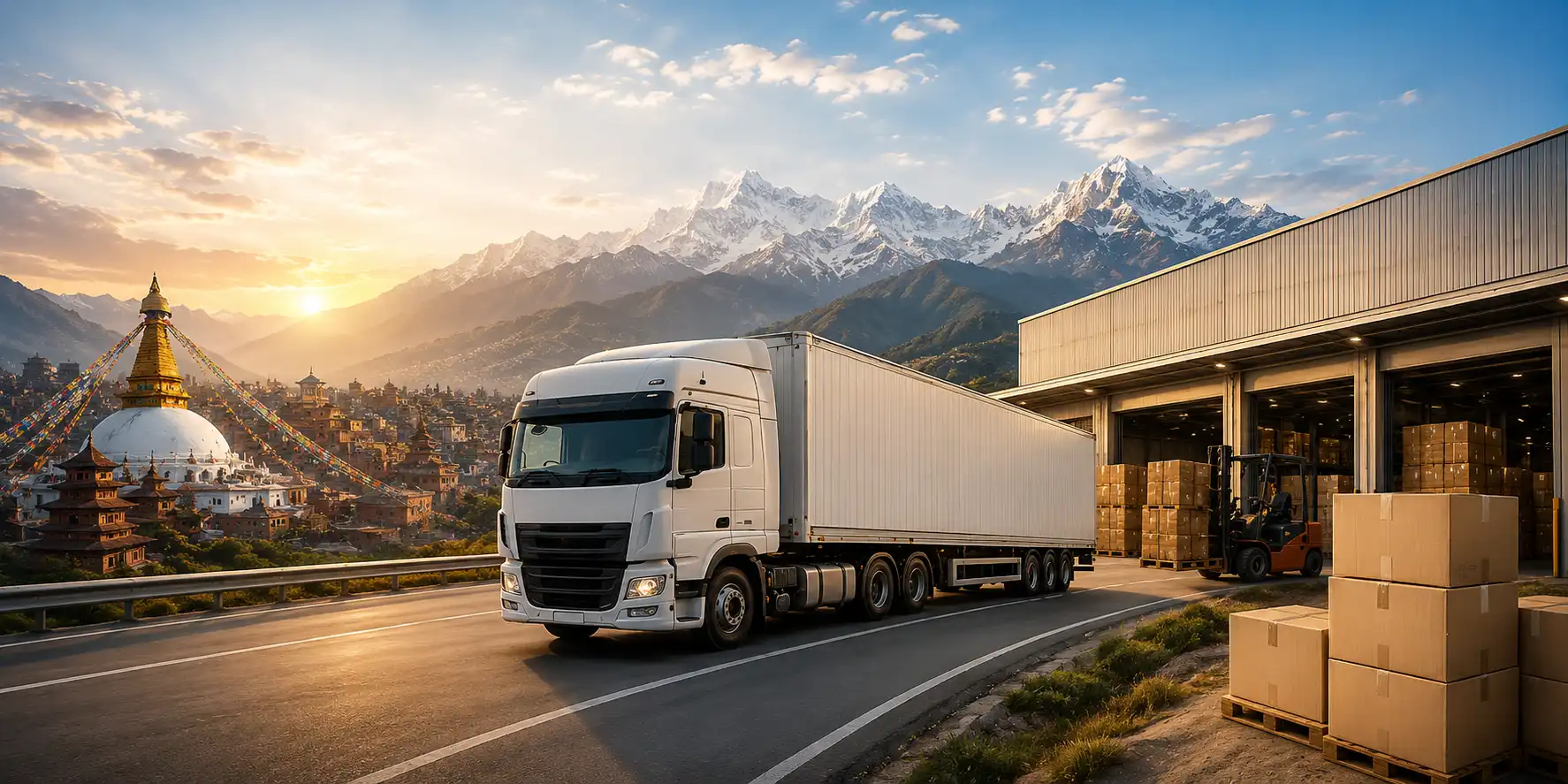
What Is Logistics in Nepal?
At its core, logistics in Nepal is the specialized process of managing the flow of goods into, out of, and across a landlocked, mountainous landscape. Unlike coastal nations that rely on direct maritime access, Nepal’s economy is "land-linked." This means every imported smartphone or exported pashmina shawl must traverse multiple jurisdictions, changing hands from sea vessels to Indian railways, and finally to heavy-duty trucks at the border.
In 2026, the Nepalese logistics system is an import-heavy ecosystem. Because the country produces limited raw materials, the supply chain is designed to facilitate the "source → international transit → border customs → inland distribution" flow. A typical journey involves moving goods from a global hub like Shanghai or Delhi, clearing them through one of Nepal’s 20+ customs points, and navigating the narrow, winding highways of the Prithvi or Siddharth Path to reach the Kathmandu Valley or other urban centers.
Key Parts of Logistics Systems
The logistics ecosystem in Nepal is a chain where every link must be reinforced to withstand the country’s unique geographic and bureaucratic pressures.
Transportation Networks
Roads are the undisputed kings of Nepal’s logistics. With limited rail access and high airfreight costs, trucks handle the vast majority of freight. The network centers on the "Strategic Road Network," which connects the southern Terai plains, the industrial heartland to the hilly regions where the majority of consumers live.
Warehousing and Storage
In a country where landslides or border strikes can halt traffic for days, warehousing acts as a vital "buffer." Modern warehouses are concentrated in Birgunj, Bhairahawa, and the Kathmandu Valley. These facilities are increasingly moving toward specialized storage, including cold-chain solutions for the growing pharmaceutical and food sectors.
Inventory Management
Effective inventory management in Nepal is a balancing act. Because lead times can be unpredictable due to monsoon rains or customs bottlenecks, businesses often maintain higher safety stocks than they would in more accessible regions. Digital inventory tracking is now becoming the standard to prevent "out-of-stock" scenarios during peak festival seasons like Dashain.
Distribution Channels
Distribution is split into two worlds: Urban and Rural. In cities like Pokhara or Lalitpur, distribution is relatively streamlined. However, rural distribution often involves "breaking bulk"—transferring goods from large 10-wheeler trucks into smaller pickups or even tractor-trailers that can handle the unpaved, steep inclines of the mid-hills.
Transport Modes in Nepal
Geography dictates the mode of transport in Nepal. Each method serves a specific purpose in the national supply chain.
Road Transport Dominance
Standard trucks and "multi-axle" vehicles are the backbone of the economy. Most goods enter via the India-Nepal border points. While efficient for bulk goods, this mode is highly susceptible to the physical condition of highways like the Nagdhunga–Naubise–Mugling stretch.
Air Cargo Role
For high-value electronics, emergency medical supplies, or perishable exports like organic tea and herbs, air cargo via Tribhuvan International Airport (TIA) is essential. While more expensive, it bypasses the weeks-long transit times of sea-and-road routes.
Rail Connectivity via India
While Nepal doesn't have an extensive domestic rail network, the Birgunj Integrated Check Post (ICP) features a functional rail link to the Indian railway system. This allow containers to move directly from Indian seaports to Nepal's "dry ports," significantly reducing the cost of heavy industrial imports.
Last-Mile Delivery Systems
The final leg of the journey is often the most difficult. In urban areas, e-commerce has popularized motorbike-based couriers. In the Himalayas, the "last mile" might literally involve porters or pack animals, though small 4WD vans are increasingly taking over these routes.
Import and Export Process in Nepal: Step-by-Step
Navigating the legal and physical path of a shipment requires a structured approach. Here is how the typical 2026 import/export flow looks:
Step 1: Place International Order
The process begins with the Proforma Invoice and the opening of a Letter of Credit (LC) or an advance payment via a Nepalese bank, ensuring compliance with Nepal Rastra Bank regulations.
Step 2: Shipping to Border or Airport
Goods are shipped from the origin country. Most sea freight arrives at Kolkata or Visakhapatnam in India, where it is then "trans-shipped" via rail or truck to the Nepalese border.
Step 3: Customs Clearance Process
This is the most critical stage. Documents like the Bill of Entry, Commercial Invoice, and Certificate of Origin are scrutinized. In 2026, the "Asycuda World" digital system helps speed this up, but physical inspections are still common.
Step 4: Inland Transportation
Once cleared and duties are paid, goods are loaded onto Nepalese trucks. They travel from the Terai border points (like Birgunj or Belahiya) up toward the destination city.
Step 5: Final Delivery to Destination
The logistics company manages the offloading at the client's warehouse or retail outlet, completing the end-to-end journey.
Logistics Challenges in Nepal
Operating in Nepal is not without its hurdles. Businesses must account for these four major constraints:
- Difficult Terrain: The extreme elevation changes from 60m to 8,848m create a "vertical" logistics challenge. Road maintenance is difficult, and monsoon-triggered landslides are a recurring seasonal risk.
- Infrastructure Limitations: While projects like the "Fast Track" highway are underway, many current roads remain narrow and congested, leading to slower "average speeds" for freight.
- Border Delays: Despite recent MoUs between Nepal and India to exchange digital data, physical congestion at border gates can still lead to "dwell times" of several days.
- High Costs: Fuel price fluctuations and the need for "dead-heading" (trucks returning empty because exports are lower than imports) drive up the per-unit cost of transportation.
Role of Logistics Companies in Nepal
This is where a professional partner like Agni Logistics becomes invaluable. A logistics company acts as a single point of contact to manage the chaos.
Freight Forwarding Services
They act as "travel agents for cargo," negotiating rates with international shipping lines and ensuring your goods don't get stuck in a port in India.
Customs Handling Support
Expert handlers manage the complex "harmonized system" (HS) codes and ensure that all duties are calculated correctly, preventing expensive fines or seizures.
Warehousing Solutions
By providing secure, strategically located storage, logistics companies allow businesses to scale without investing in their own real estate.
End-to-End Supply Chain Services
From the moment a factory in another country finishes a product to the moment it sits on a shelf in Kathmandu, a logistics partner manages every handoff.
Future of Logistics in Nepal
The horizon for Nepalese logistics is bright. Several key trends are transforming the industry in 2026:
- Infrastructure Projects: The completion of new dry ports and the expansion of the East-West Highway are set to slash transit times.
- Digital Transformation: Real-time GPS tracking and AI-driven route optimization are helping companies bypass traffic and predict delays.
- E-commerce Boom: The rise of online shopping in Nepal is forcing logistics providers to become faster and more tech-savvy with "hyperlocal" delivery.
- Regional Trade: Improved connectivity with China via the Tatopani and Rasuwagadhi borders is providing a vital alternative to the southern trade routes.
Work With Agni Logistics Nepal
Navigating the complexities of the Nepalese market requires local heart and global expertise. Agni Logistics offers a seamless bridge for your business, providing reliable freight forwarding, customs clearance, and distribution services tailored to Nepal’s unique geography. Don't let the mountains slow you down—partner with a team that knows every turn in the road.
Contact Agni Logistics today for a custom quote or supply chain consultation.
FAQs About Logistics in Nepal
How does logistics operate in Nepal?
Logistics in Nepal operates primarily through a "land-linked" model. Goods are imported via Indian seaports, transported by rail or road to border Integrated Check Posts (ICPs), cleared through customs, and then distributed across the country via a dominant road network.
Why is logistics challenging in Nepal?
The primary challenges include the rugged Himalayan terrain, high dependency on cross-border transit through India, limited road infrastructure, and the high cost of transportation relative to the value of goods.
What transport is most used in Nepal?
Road transport is the most used mode, accounting for over 90% of internal movement. Trucks are the primary vehicles for both cross-border trade and domestic distribution.
How long does shipping take in Nepal?
Shipping times vary: Air cargo usually takes 3–7 days from global hubs, while sea-to-road transit from international origins via Indian ports typically takes 20–35 days, depending on customs and road conditions.
What do logistics companies do in Nepal?
They provide an integrated suite of services including international freight forwarding, customs brokerage, warehousing, inventory management, and last-mile delivery to ensure a smooth flow of goods.